Sharing space, not conversations: the overlooked role of acoustics in professional services offices
In legal and professional services environments, sound carries weight. Conversations are often sensitive, work demands deep concentration, and client trust underpins everything. When acoustics fall short, the impact is felt quickly in focus, confidence and day-to-day effectiveness.
As hybrid working and video calls have become embedded, acoustic demands have increased. Offices now host overlapping conversations, informal collaboration and calls taking place throughout the day, often within layouts originally designed for quieter, more predictable use. In UK legal firms, more than 80% of employees now work in hybrid patterns, placing sustained pressure on spaces that were never designed to operate this way.
Acoustic issues rarely derail a project on paper, but they have a habit of surfacing once the office is fully occupied and operating at pace.
In a 2025 survey of 2,000 UK office workers, 56% said their office is too noisy and only 29% felt their office acoustics meet their needs, with many reporting changing where or when they work to avoid distraction. That matters for professional services firms, because it hits three things at once: productivity, wellbeing and retention.
For firms where precision and discretion are part of the brand promise, these patterns have real operational and cultural consequences.
Are you a legal or professional services firm?
We design offices that protect focus, discretion and performance as teams grow and ways of working change.
Acoustics, focus and cognitive performance
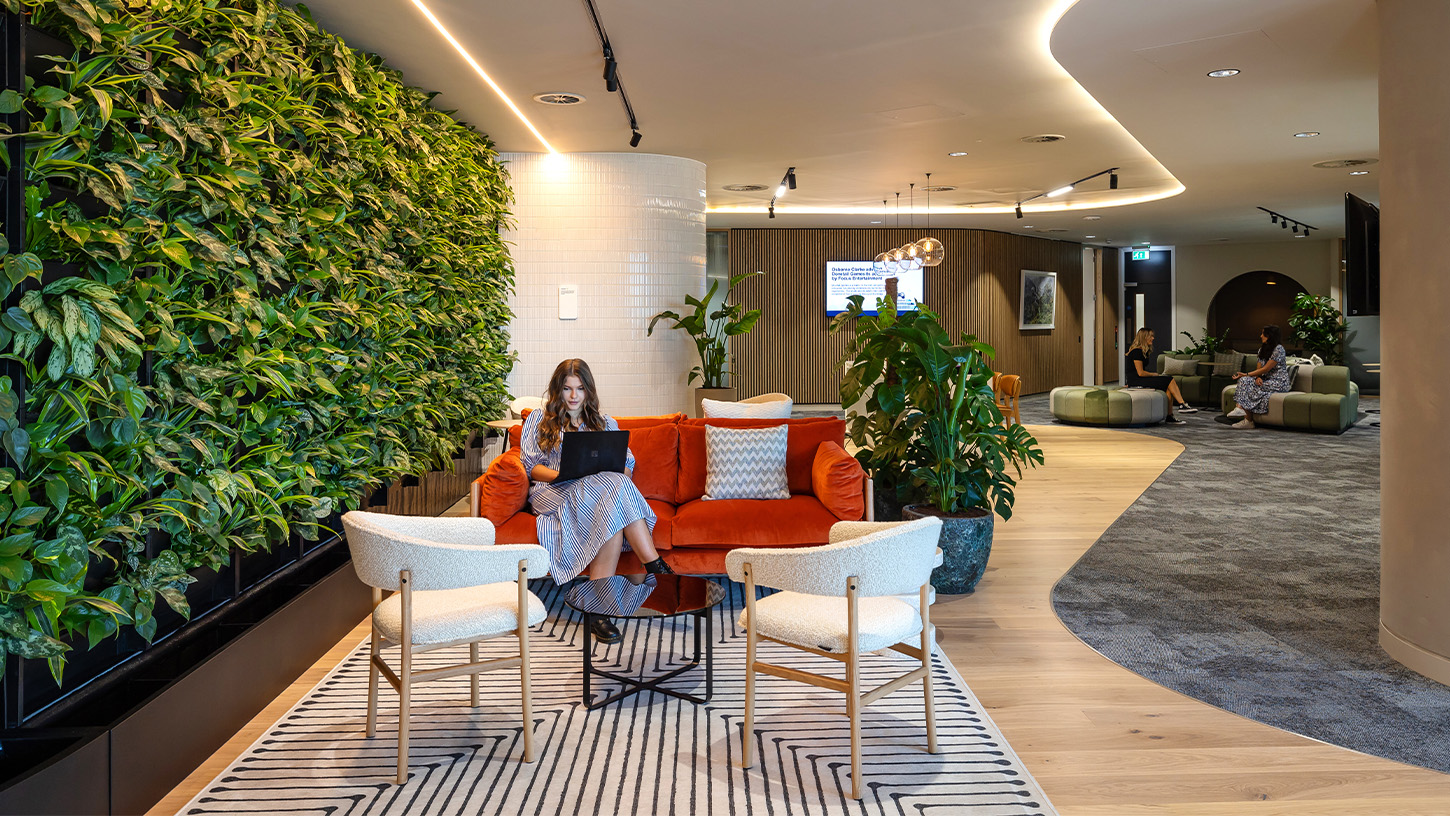
Noise doesn’t need to be loud to be disruptive. Unpredictable or intermittent sound – nearby conversations, phone calls, keyboard noise, or even the winter cacophony of coughing and sneezing – places a constant demand on attention.
One of the best known findings on distraction is that, on average, it can take around 23 minutes to fully resume a task after an interruption. In professional services, where the work is often high stakes and cognitively demanding, that “stop-start” effect adds up fast.
Other research into workplace distraction shows that conversational noise can significantly impair short-term memory and task accuracy, particularly for complex, cognitively demanding work. For lawyers, consultants and advisers, this type of work is the norm rather than the exception.
What we often see in practice is not one big acoustic failure, but a slow erosion of focus. People move desks. Teams avoid certain areas. Meeting rooms are overbooked because they feel safer. These behavioural workarounds are early signs that the space is not supporting how people actually work.
Good acoustic design reduces this cognitive load, allowing people to maintain concentration without constantly managing their environment.
Confidentiality in increasingly collaborative workplaces
Confidentiality is often discussed in terms of policy, behaviour and technology. Yet, the physical environment plays an equally important role, particularly as professional services firms embrace more collaborative ways of working.
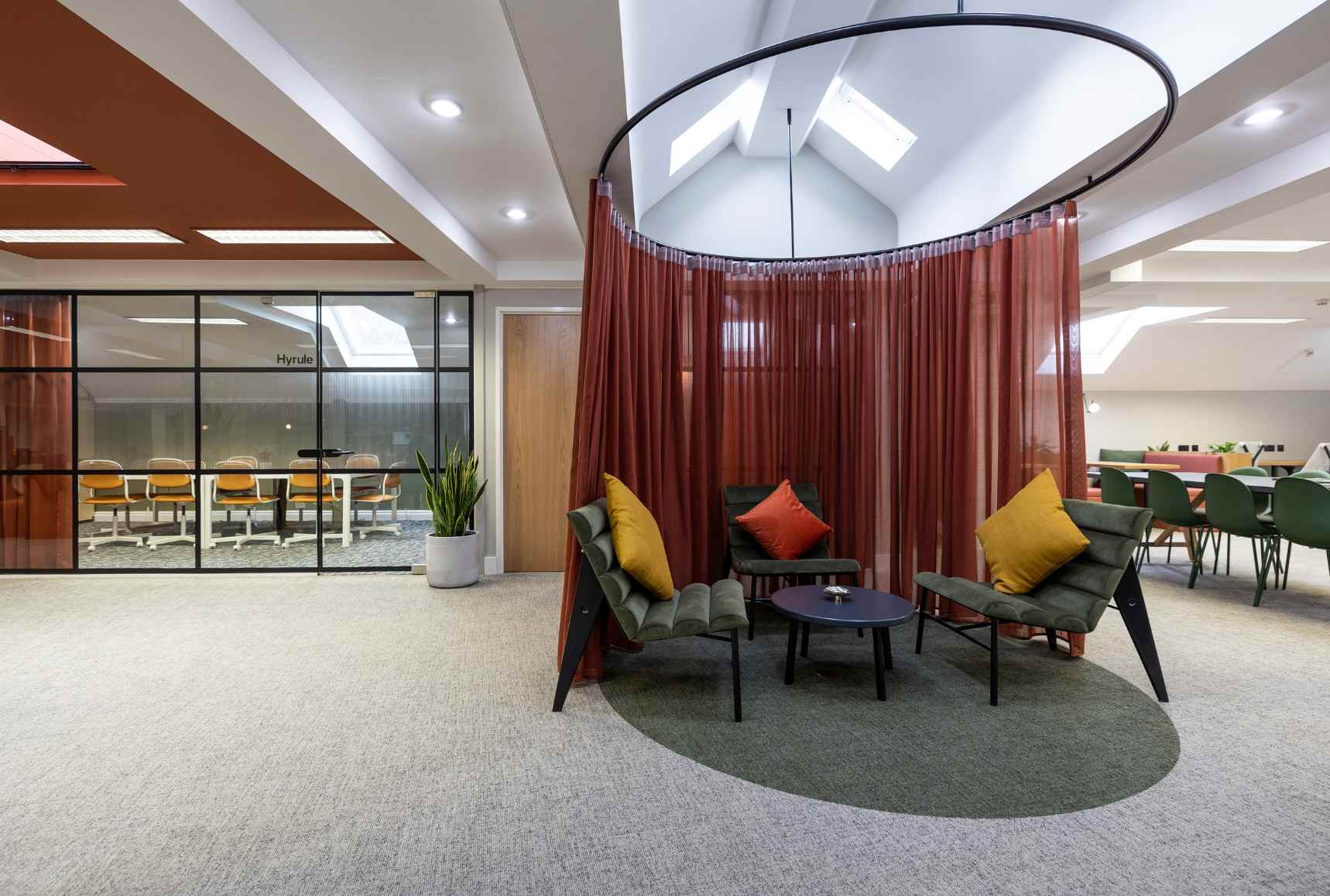
Open plan work areas, shared project tables and informal meeting spaces support knowledge sharing, mentoring and faster decision-making. But, they also change how sound behaves across an office. Sensitive conversations no longer happen solely in meeting rooms. Client calls, internal discussions and problem-solving conversations increasingly take place in open settings, often alongside focused work.
One well-documented challenge in these environments is the “halfologue” – overhearing one side of a conversation. Research shows this is especially disruptive, as the brain instinctively tries to fill in missing information, pulling attention away from the task at hand.
Designing for acoustic privacy in this context is about balance. It means enabling collaboration without allowing sound to travel unchecked, and supporting discretion without forcing teams back into enclosed, siloed spaces. When people trust their environment to manage sound appropriately, collaboration feels easier and focus is protected.
The “legal brand” factor
By 2030, all commercial buildings need to meet EPC B or better, and that deadline is influencing investment. In some sectors, a lively, buzzy office is part of the identity. In professional services, calm is often a signal of trust.
A quiet, well-managed acoustic environment communicates:
- Discretion
- Competence
- Control
- Sensitivity
If a client can hear a negotiation through a meeting room wall, or if reception feels chaotic and echoey, the space is saying something about risk, even if the work is excellent.
Done well, acoustics become a form of “acoustic luxury” – not silence, but effortless calm.
Inclusive design and sensory comfort
Acoustics play a significant role in creating inclusive workplaces. Neurodivergent employees, including people with autism, ADHD or sensory processing differences, can experience heightened sensitivity to noise. Poor acoustic conditions can contribute to fatigue, headaches and reduced concentration, particularly in open or highly active spaces.
As Sarah Pasquall, Creative Lead at Interaction, explains:
“When we talk about inclusive workplaces, acoustics are often one of the most overlooked factors. For neurodivergent people in particular, background noise and unpredictable sound can make it much harder to focus or feel comfortable. Designing for acoustic comfort creates choice and control, allowing people to work in ways that suit them.”
Learn more about inclusive workplace design here.
What we’ve learned from delivering professional services offices
Having delivered workplaces for law firms and professional services organisations over many years, a few patterns come up again and again.
Acoustic issues are rarely identified during early design sign-off. They tend to appear months after move-in, once teams are fully settled and working patterns become clear. This is where our Client Care team often gets involved.
Post-completion, we regularly support clients with acoustic refinements. These range from introducing additional desk screens between teams, to upgrading meeting room soundproofing that initially appeared sufficient. In some cases, sound travels unexpectedly through building systems such as HVAC ductwork, carrying noise between rooms in ways that are difficult to predict without specialist input.
These issues are common, not exceptional. What they highlight is that acoustics are one of the hardest elements to retrofit well, and one of the easiest to underestimate early on. The most effective way to avoid costly and disruptive changes later is to involve design specialists and acoustic consultants from the outset, while layouts, materials and building services can still be coordinated holistically.
The ABC of acoustics
Most strong acoustic strategies combine three levers:
A – Absorb
Reduce reverberation so sound does not build up in the space. This is where carpets, ceiling baffles, acoustic wall panels and other soft or porous finishes earn their keep.
B – Block
Stop sound travelling where it should not. This can mean properly detailed meeting rooms, privacy pods, high-backed furniture, partitions, and the unglamorous details (door seals, slab-to-slab partitions, weak points around glazing and services).
C – Cover
Use sound masking to make speech less intelligible over distance by introducing a low-level background sound tuned to the frequency of human speech. In professional services offices, this is often used to protect speech privacy in open plan areas and client-facing zones without making the office feel hush-hush.
The best results come when these are designed together, early, not added as sticking plasters later.
Case study: TLT, Manchester
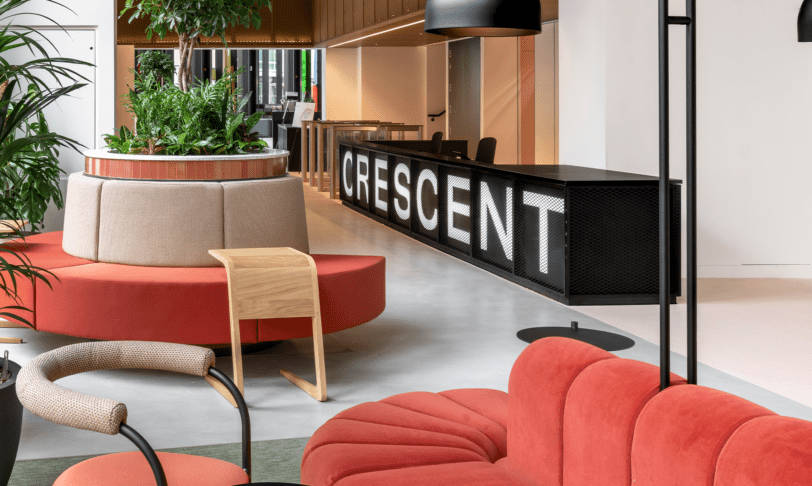
At TLT’s Manchester office in the Eden building, acoustics were integral to the space. In contrast to traditional law offices, the space was designed to feel open, welcoming and people-focused. A conventional reception desk was replaced with an informal conciergerie. Teapoints, collaboration areas and a coffee lounge encourage movement and interaction throughout the day.
These choices support culture and connection, but they also change how sound behaves across the office. With more activity taking place in open and shared spaces, acoustic performance needed to be considered from the outset.
Solutions were woven throughout the design, including:
- Soundproof focus pods to support concentrated work and private calls
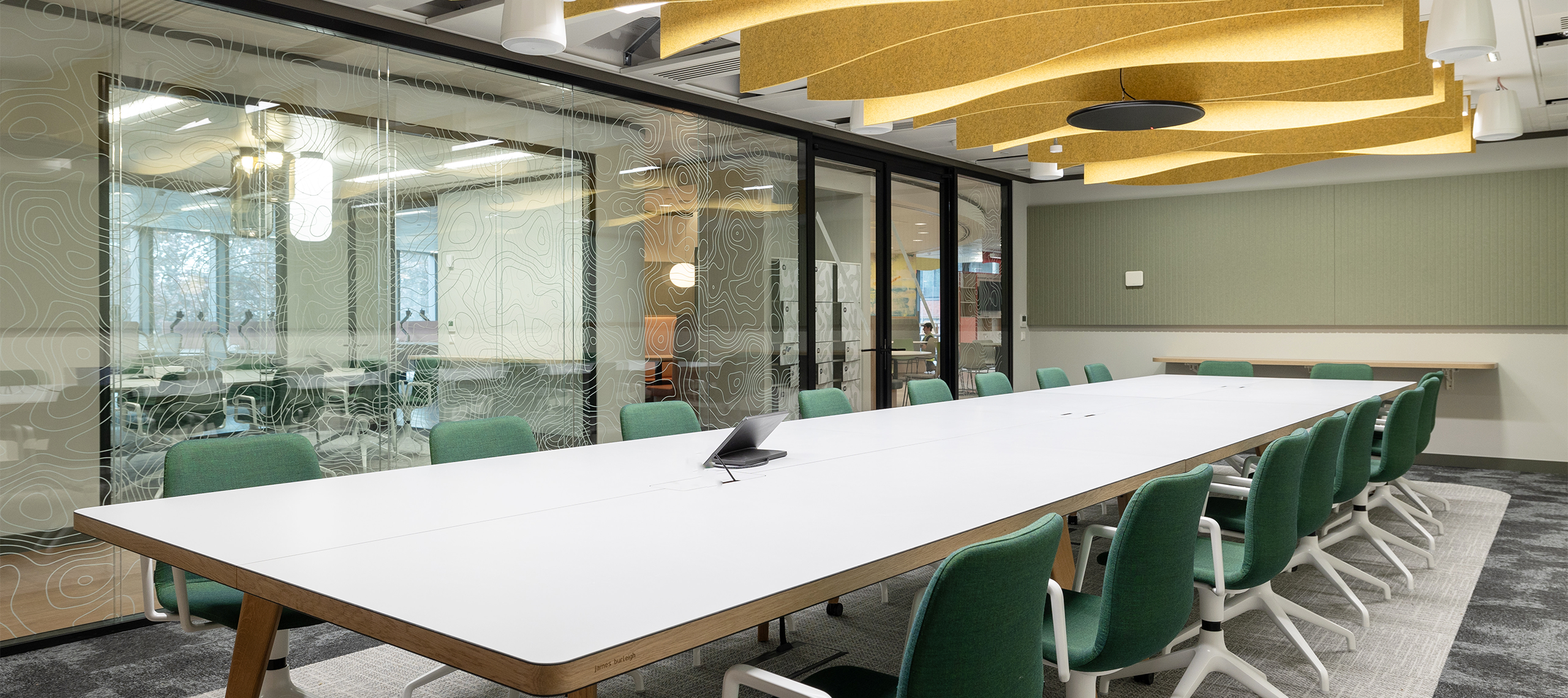
- Acoustic ceiling baffles in meeting areas to manage reverberation
- Wayfinding carpet to reduce noise and support intuitive navigation
- Desk-level screens between workstations
- Soft furnishings and upholstery that contribute to sound absorption
Zoning and access-controlled areas further support discretion where required. Rather than relying on a single intervention, the acoustic strategy works across layout, materials and detailing to support a more open, collaborative workplace without compromising confidentiality or focus.
Interested in learning more about workspace design for legal firms? Read our guide.
Case study: Arup, Bristol
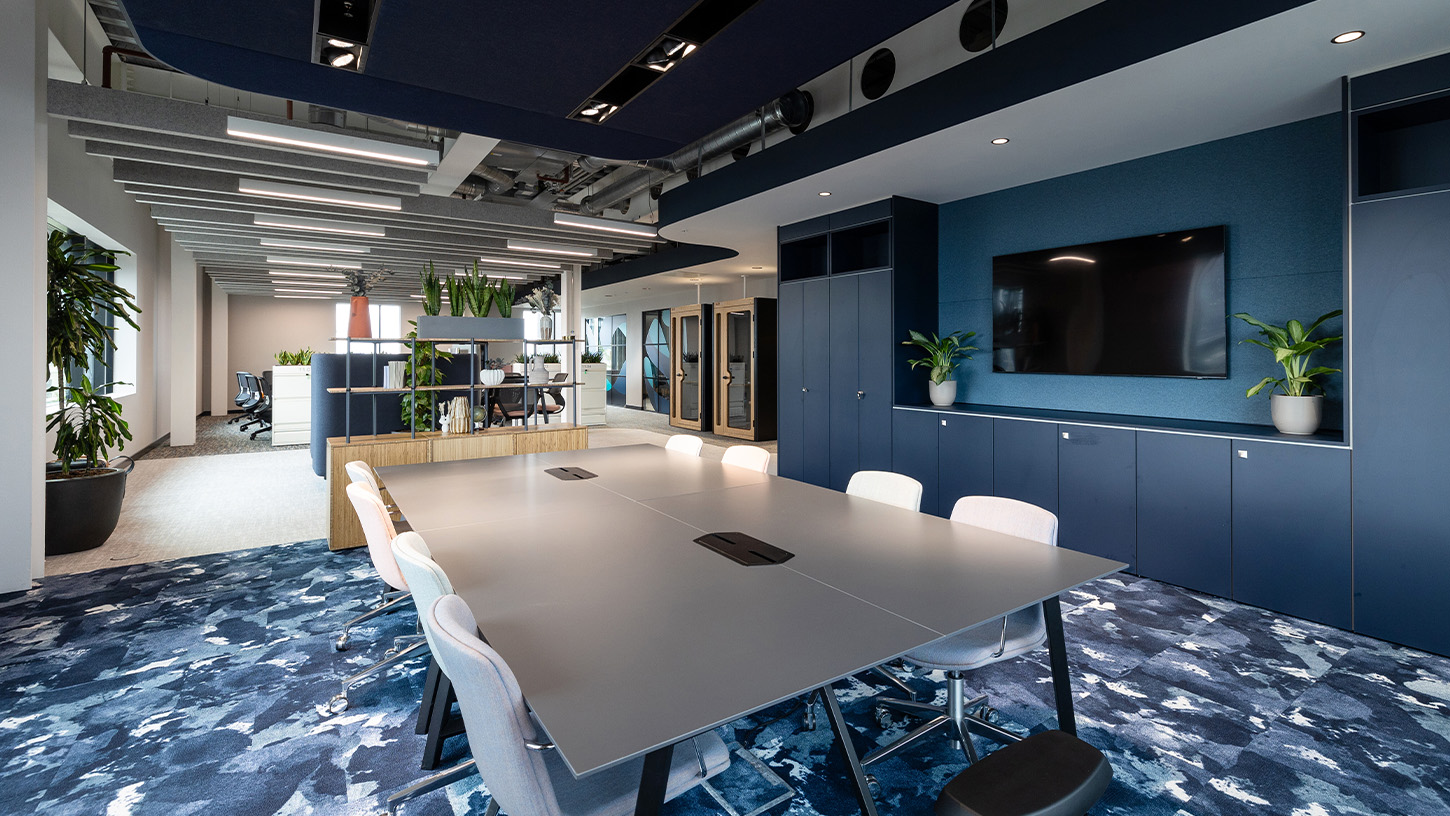
For Arup’s Bristol office, acoustic performance was a defining part of the design, shaped directly by how the team wanted to use the space.
Through workplace strategy consultations and workshops, we worked closely with the Arup team to understand patterns of work across the office. The space needed to support focused individual work, collaborative project activity and informal interaction happening side by side. That insight informed both the layout and the acoustic approach.
Sculptural acoustic baffles run through the ceiling, forming a strong visual feature while controlling reverberation across large open areas. Their layered form absorbs sound where collaboration is encouraged, helping prevent noise from travelling across the floorplate while keeping the space open and connected.
By grounding acoustic design in a clear understanding of how the office would be used, sound is managed through design rather than restriction. The result is a workspace that feels comfortable, expressive and well suited to hybrid working.
Putting this into practice: key design principles
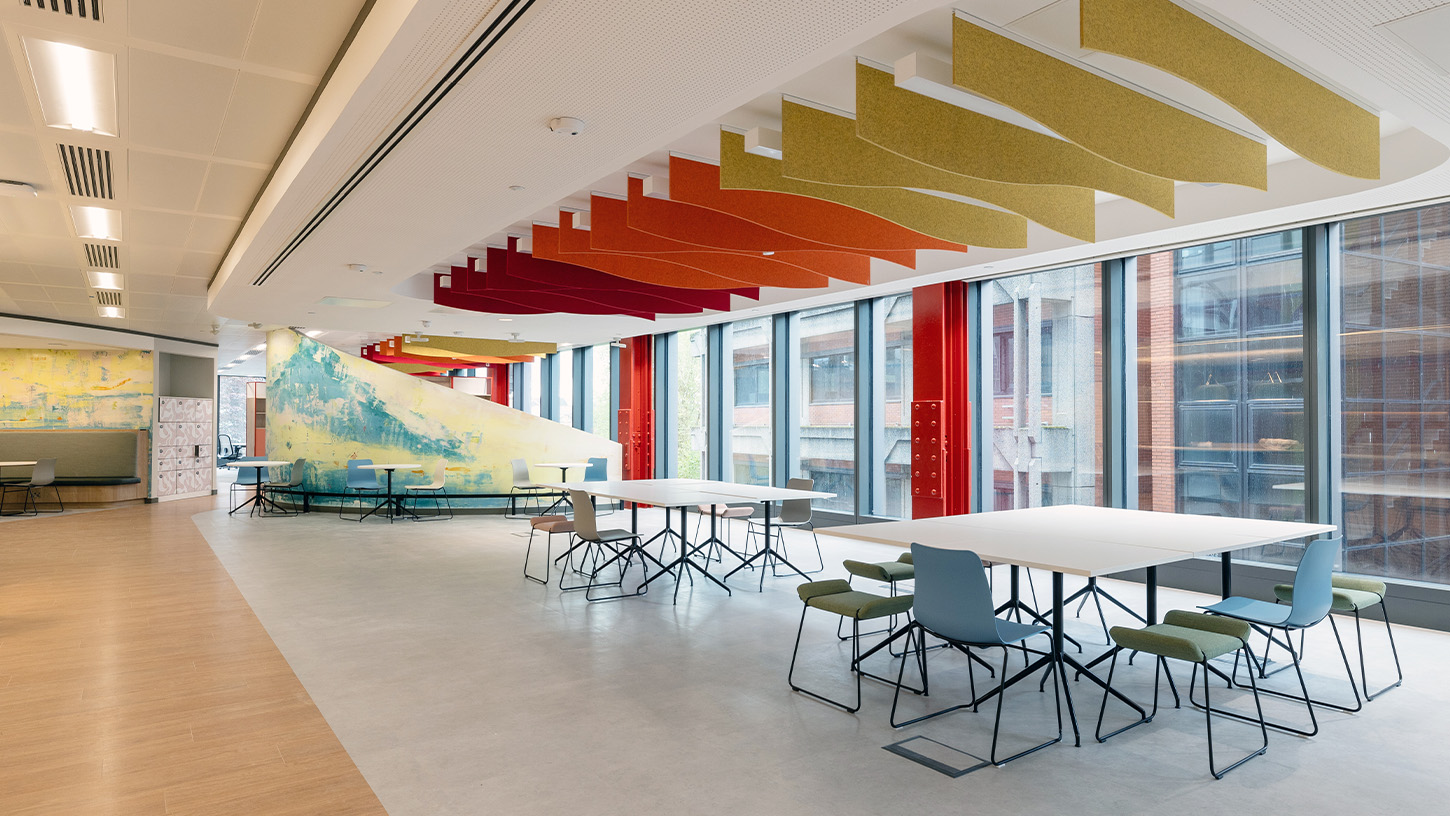
Across professional services offices, the most effective acoustic strategies tend to share the same characteristics:
- Consider acoustics early
Sound is addressed alongside layout, adjacencies and building services, not added once designs are fixed. - Design for hybrid realities
Call-heavy activity is planned for across the workplace, not squeezed into too few rooms. - Use layered solutions (the ABC)
Absorb, block and (where appropriate) cover work together so no single product has to “save” the space. - Build in clear acoustic zoning
Different areas are designed for different sound levels, with natural transitions between focus, collaboration and client-facing zones. - Protect speech privacy where it matters
Design for discretion in the places clients and teams expect it, so people do not have to self-censor. - Design for inclusion and comfort
Acoustic comfort supports a wider range of working styles and sensory needs.
From experience, projects run most smoothly when these principles are embedded early. Where acoustics are assumed to take care of themselves, issues tend to surface later, when changes are more disruptive and costly to resolve.
A strategic view of acoustics
Acoustics shape how a workplace functions long after the project completes. They influence focus, wellbeing, communication and trust, often in subtle ways that only become visible over time.
At Interaction, acoustics are treated as a core part of workplace design, informed by strategy, experience and long-term client relationships. Our role is often to spot acoustic risks before they surface, helping clients avoid costly changes and create environments that continue to work well months and years after move-in.
If you’re thinking about how your workplace supports focus, confidentiality and long-term performance, take a look at how we work with professional services firms, or speak to an expert today.