Five questions HR should ask before approving a workplace design brief
Most workplace briefs start with Property and Facilities.
How much space do we need? How many desks? What will it cost? What should the Cat B fit-out include?
All important questions. But none tells you whether the finished workplace will actually work for the people using it.
Because a floor plan influences who collaborates. An acoustic strategy affects who can concentrate. And a relocation can strengthen a company’s culture; or simply give its old problems a shiny new address.
That’s why HR and People teams need a seat at the table before the workplace brief is signed off. Here are five questions worth asking.
1. What do you actually want people to do differently?
‘Get people back into the office’ isn’t a workplace strategy.
You can fill every desk and still have an office full of people sitting on Teams calls, wearing headphones and wondering why they bothered commuting.
The better question is: what should the workplace help people do that they can’t do as well elsewhere?
Perhaps that’s:
- More cross-team problem-solving
- Better onboarding and informal learning
- Stronger relationships between senior and junior colleagues
- More productive client collaboration
- Proper space for focused work
Pick three to five priorities. Then challenge every major briefing decision against them.
If you can’t explain what behaviour a space is supposed to support, you’re probably making a design choice rather than a business decision.
Our workplace strategy approach starts with understanding people, culture and working patterns; the most vital elements to consider from the word go.
2. Are you protecting focus as seriously as collaboration?
Collaboration sells an office. Big shared tables, impressive breakout areas and buzzing social spaces look great on a tour.
Concentration is less photogenic.
But an office with nowhere to think, write, analyse or take a difficult call quickly becomes somewhere people avoid when they need to get something done.
The answer isn’t more meeting rooms or fewer desks. It’s understanding how people spend their working week and giving them the right mix of settings.
That means quiet zones, confidential spaces, collaborative areas and places for informal conversation, without making one activity the enemy of another.
As we explore in the proximity myth: collaboration doesn’t live 20cm closer, squeezing desks together doesn’t automatically improve communication.
A busy office isn’t necessarily a productive one.
3. Have you designed for variation, or an imaginary ‘average’ employee?
Everyone experiences the workplace differently.
Noise that one person barely notices can make concentration impossible for someone else. Bright lighting, visual clutter, temperature, proximity and interruptions can all affect how comfortably people work.
These differences can be particularly significant for neurodivergent colleagues, but inclusive design shouldn’t depend on someone disclosing a diagnosis or requesting special treatment.
Often, the most effective solutions are surprisingly straightforward:
- Better acoustic zoning with genuinely quiet spaces
- Areas with different levels of sensory stimulation
- Choice over where and how to work
- Adjustable lighting and environmental controls where practical
- Spaces people can use without having to justify why they need them
Inclusion doesn’t stop at neurodiversity.
As working lives extend, workplaces must also accommodate changing needs around hearing, vision, mobility, dexterity and comfort.
Our Age-Inclusive Fit-Out Checklist looks at the details that are easily missed during a fit-out, but can make a considerable difference to someone’s working day.
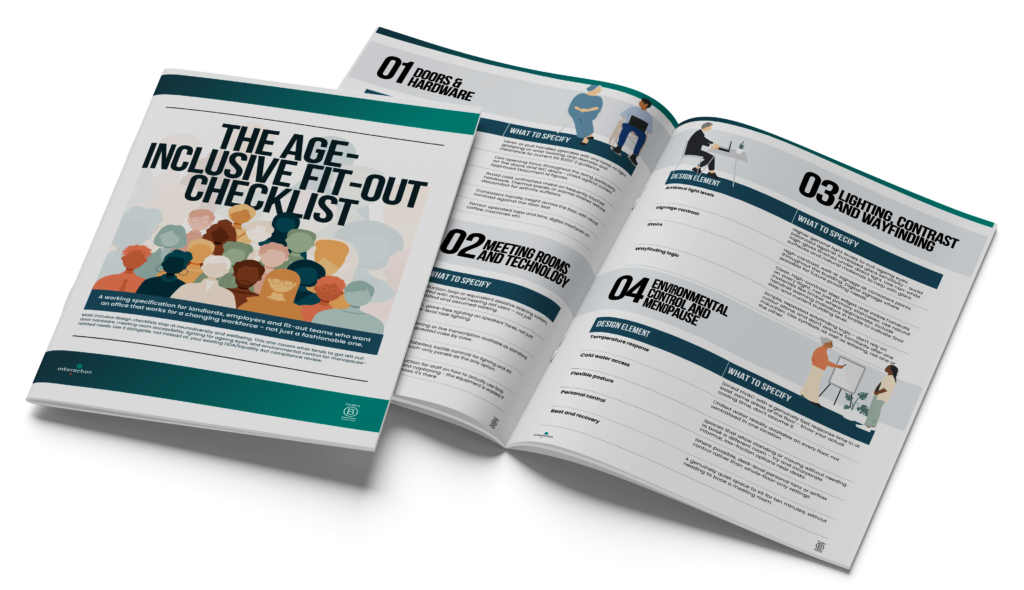
Inclusive design isn’t a finishing touch. It’s all part of designing a workplace that works for more people in the first place.
4. Who owns the change management?
A relocation can be delivered perfectly and still fail.
The desks arrive. The technology works. Everyone knows where the coffee machine is. But nobody has explained what’s supposed to be different about working there, so people recreate their old habits in a new building.
Property can manage the project. Facilities can manage the space. IT can manage the technology.
What’s often missing is a fixed person to manage and owning the human transition. Appoint someone to involve employees before decisions are fixed, explain the rationale behind the change and give managers the right information and support to help their teams adapt.
Employee engagement, manager briefings, working groups, onboarding and practical guidance all help people understand the purpose of their new workplace, and in turn make better use of it.
We saw this in our work with GKN Aerospace. Before designing its Global Technology Centre, we carried out utilisation studies across four sites, including employee surveys, interviews and working groups to understand how teams worked and what needed to change.
The resulting workplace supported more agile working, collaboration and learning, with an onboarding handbook helping people understand and use the new environment.
That’s the difference between handing over an office and helping an organisation move forward.
5. How will you know whether it worked?
Most workplace projects have a very clear definition of success: on time. On budget. Everything working. Snagging complete.
Then on moving day, the measurement stops.
A successful handover isn’t necessarily a successful workplace. Before signing off the brief, agree what you actually want to improve, and keep track of it.
That might include:
- Employee satisfaction and workplace experience
- Ability to concentrate and collaborate effectively
- How different spaces are used
- Attendance patterns and employee preferences
- Feedback on specific workplace frustrations
- Recruitment and retention, where a credible connection can be established
Take a baseline before the move, then review what has changed after three months and again after 12. This is how you’ll understand if your new workplace is delivering what the business paid for.
The most expensive workplace decisions are often made too early.
This isn’t about HR taking control away from Property or Facilities. It’s about getting the right people around the table while decisions can still be challenged.
Property understands the asset. Facilities understands its operation. Designers know how to turn requirements into spaces.
People teams understand the culture, behaviours and employees the workplace needs to support. And that knowledge becomes considerably more expensive to act on once the design has been signed off.
At Interaction, we’ve seen what happens when those perspectives come together early. On projects like GKN Aerospace and TLT Glasgow, the brief was about far more than creating an attractive office. It was about supporting how people work, connect and collaborate.
Because beautiful is the baseline. Useful is the point.
Before you sign off the brief, let’s talk.
The best time to challenge a workplace brief is before changing it becomes expensive.
Our workplace strategy team works with People, Property and Facilities leaders to understand what your organisation needs from its space, and how to translate that into a working brief.