Designing offices for health tech companies
Health tech companies have a harder workplace brief than most people realise. Most health tech offices fail for the same reason: they’re designed like tech companies, or like labs.
Health tech is neither.
On the surface, the ask looks familiar: create somewhere that attracts great talent, supports collaboration, expresses the brand, and gives people a reason to come in. But underneath that sits a different layer of complexity. Sensitive data. Clinical, quality or testing workflows. Teams with very different working patterns. Compliance awareness. And a pace of growth that can outrun the office before the paint has dried.
Get the balance wrong, and you end up with a workplace that either feels too loose (noisy, open, hard to concentrate in, poorly suited to controlled work) or too rigid, the kind of sterile facility environment that repels the software engineers and product leads you’re trying to hire.
The health tech companies that get it right start somewhere different. Not with finishes, floorplates or furniture. With strategy.
Where innovation culture meets operational complexity
A pure tech office is usually designed around openness. Big collaborative zones, shared tables, social anchors, visible energy. That model works well when the work is primarily creative, iterative and loud. But it doesn’t serve a team that needs focus, confidentiality, or process control.
A traditional life sciences environment goes the other way. The technical standards are right, but the atmosphere can feel more like a facility than a home for a scaling business.
Health tech lives in between. The middle ground is where design has to do its most careful work.
The office needs to feel energised and human enough to win talent away from pure-play tech employers. It also needs to be operationally credible: a place where sensitive work can happen confidently, where different teams aren’t constantly in each other’s way, and where the business can grow without the workplace becoming the bottleneck. Design constraints may have to take into account screen positioning to prevent shoulder-surfing in open areas, storage layouts driven by audit trails rather than convenience or teams avoiding certain areas because conversations can be overheard.
That’s a more nuanced brief than most generic fit-outs are built to handle.
For businesses with more technical operational environments, our designing spaces for highly regulated environments article is worth a read.
The questions that matter
A standard workplace brief asks how many desks, meeting rooms and breakout areas you need. A better health tech workplace brief asks something more fundamental: what does this office need to make possible?
That shifts the conversation from aesthetics to operating model. It forces the right questions early:
- Which work is sensitive, and where does it need to happen?
- Which teams need to be physically close to each other?
- Where are the operational pinch points today (and where will they be in 18 months)?
- What does the office need to signal to the candidates, investors and partners who walk through the door?
- Which activities genuinely need acoustic separation, restricted access, or controlled environments?
Answer those questions first, and the design brief writes itself. Skip them, and you’re choosing carpet before you know what the building needs to do.
What it costs to get it wrong
Getting your approach wrong can be costly. This is where you may see:
- Talent risk: candidates decline after visiting the office
- Operational drag: teams creating workarounds outside the workplace
- Financial cost: reconfigurations within 12–18 months
- Reputational risk: space doesn’t match regulatory or investor expectations
These costs may also appear in more subtle ways. Maybe clinical teams are pushed into open plan to ‘integrate’… then quietly working from home to get anything done. Product teams might be seen occupying meeting rooms all day because there’s nowhere to pin work up, or compliance requirements might be discovered post-design, triggering expensive reconfigurations.
Designing for difference
One of the defining challenges of health tech office design is that a single workplace has to serve several genuinely different groups of people, and they don’t use space in the same way.
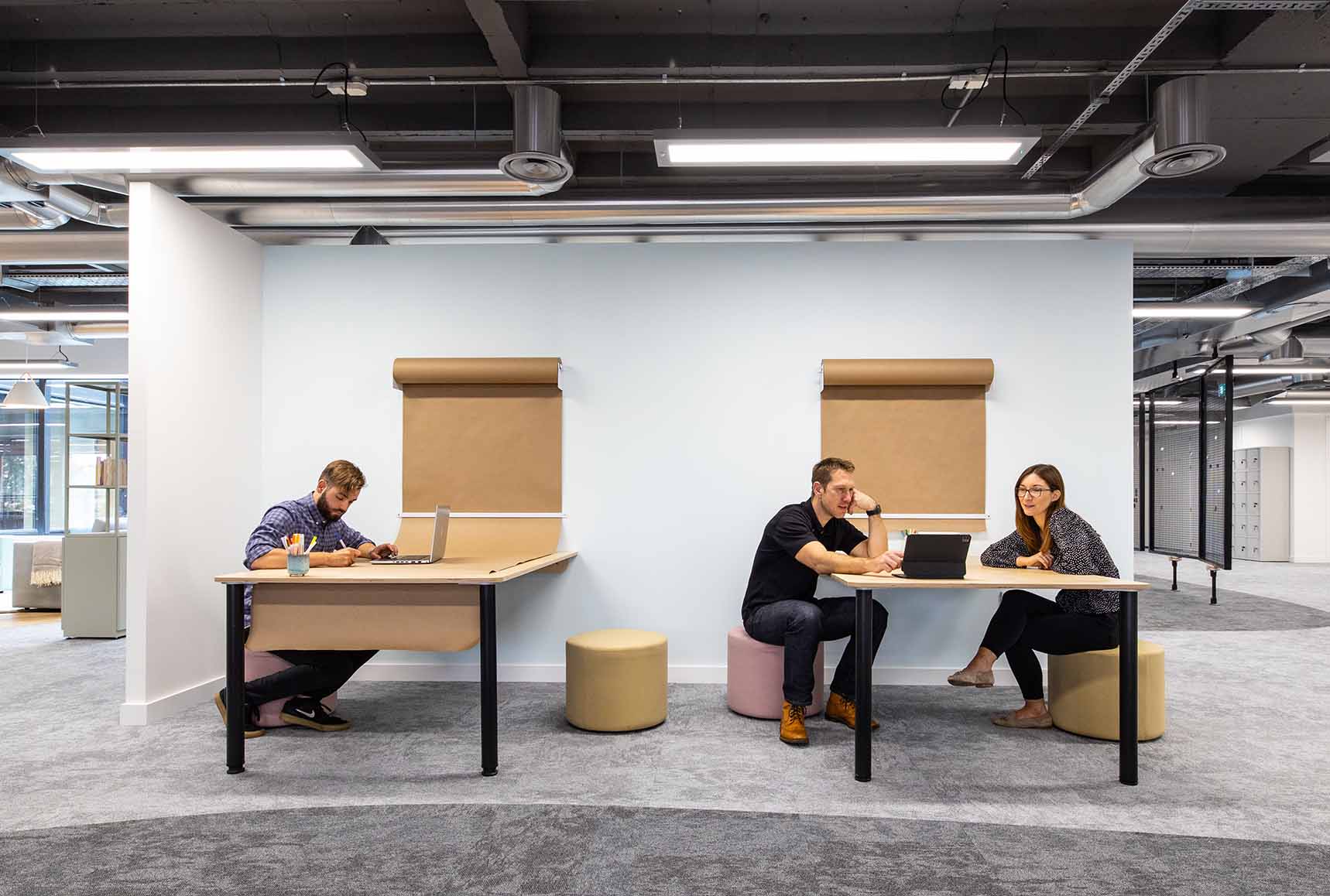
A founder needs calm and privacy for investor calls. A product team needs wall space, fast iteration, and somewhere to think out loud. Engineers need deep focus. Commercial teams need energy, quick access to meeting rooms, and client-ready settings. Clinical, quality or operations staff need process clarity, documentation space, and a degree of separation from the noise. People teams need a space that helps new starters feel connected quickly. These aren’t variations of the same work. They’re fundamentally different modes and they need different environments
Trying to serve all of that with one undifferentiated open plan is a recipe for constant friction.
Good zoning means designing a workplace with enough structure that different work modes can happen without collision. Quiet focus zones for deep technical work. Project rooms that support product and clinical collaboration. Acoustically controlled spaces for sensitive calls and confidential conversations. Social settings that build culture without undermining concentration. Hybrid-ready meeting infrastructure that works as well for a board session as for a daily stand-up.
When the layout is right, people don’t need a manual to understand it. They arrive, read the room, and go where the work takes them. An intuitive understanding of the space is important; in a scaling business, small daily inefficiencies compound quickly.
The office as part of your talent story
Health tech companies typically compete for software engineers, product managers and data specialists against employers with bigger salaries, stronger brand recognition and more established benefits packages. The office won’t close that gap on its own. But it can help.
What candidates are looking for isn’t necessarily flash. They’re looking for evidence. Evidence that the business is serious, that the mission is real, that the environment is one where they could do meaningful work with good people. They’re looking for credibility, not perks; signals that tell them “I can do serious work here without friction”, or “this company understands highly-regulated environments”. The office is where that case is made crystal clear; it’s where innovation is signaled by operational clarity, not a doughnut bar and a ball pool.
That means the workplace needs to balance purpose with performance.The best health tech offices borrow intelligently from tech office design without copying it wholesale. They have the collaboration settings, the social anchors, and the brand expression, but they also have the discipline, privacy and operational confidence that the work demands. One reinforces the other.
Future-proofing before you need to
Scaling health tech businesses can outgrow their workplace assumptions faster than almost any other sector. A 60-person company can become a 120-person business within a year. Leadership structures change. Product priorities shift. New regulatory requirements emerge. What worked in year one starts to creak in year two.
Future-proofing isn’t about designing a half-empty office for a headcount that may never arrive. It’s about making decisions now that reduce the cost of change later.
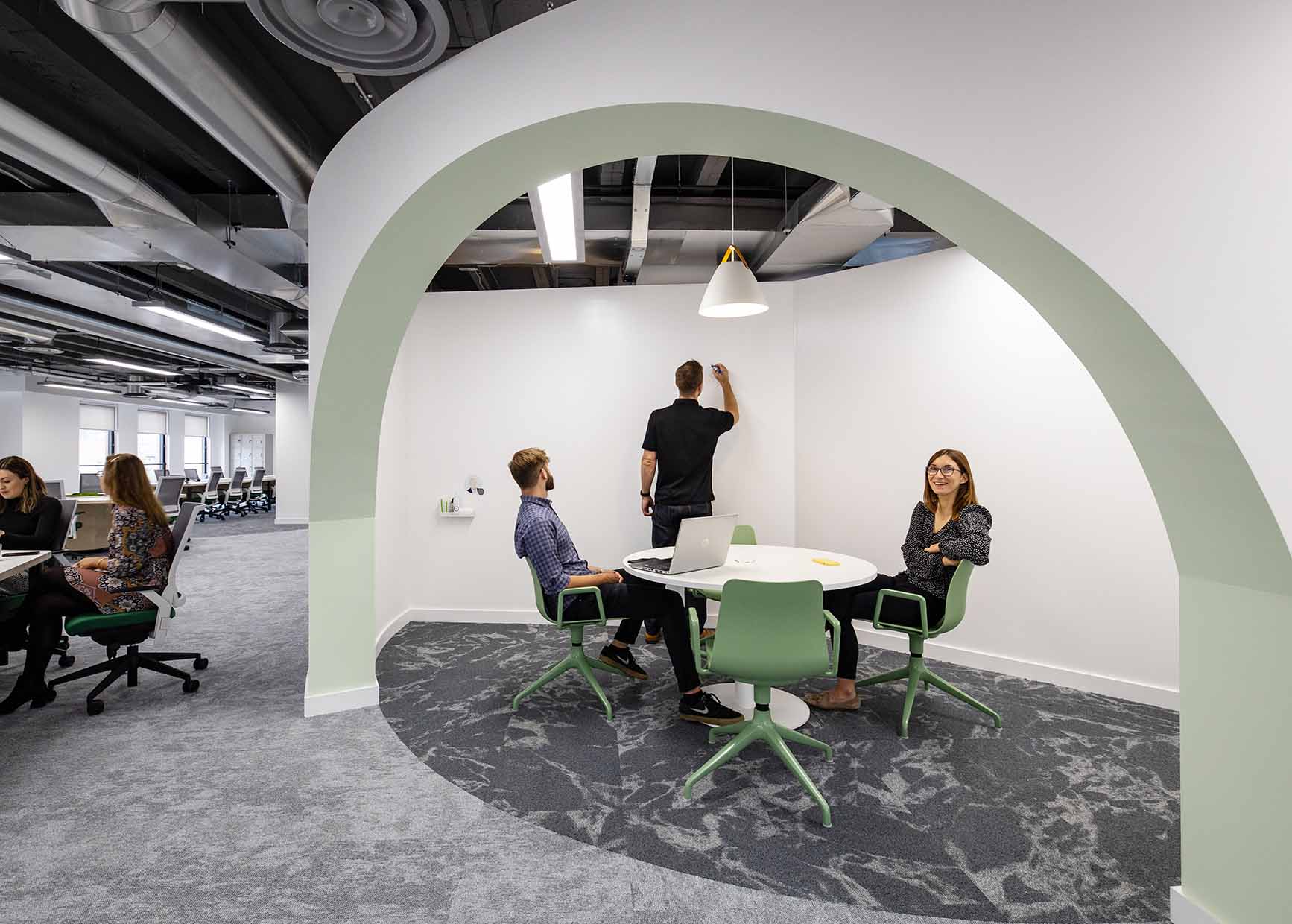
That might mean modular planning, adaptable meeting rooms, demountable partitions, infrastructure routes that can support reconfiguration, or furniture settings that can be repurposed as the organisation evolves.
It also means being honest about where the pressure is most likely to build. In our experience, the first failure point is rarely the number of desks. It’s meeting capacity. Acoustic privacy. The absence of places for managers to have sensitive conversations. Collaboration space that was built for a team of thirty and is now being used by eighty.
A strategy-first process protects against over-investing in the wrong things. It extends the working life of the office, reduces the risk of premature moves, and avoids the expensive rework that comes from getting the brief wrong first time.
What good actually looks like
A successful health tech workplace is defined by how well it supports the business.
That means operational clarity. People know where to focus, collaborate, take sensitive calls, and manage controlled work without having to think about it.
It means privacy without isolation. Teams can protect confidential workflows without the office feeling closed or fragmented.
And it means credibility. When a candidate walks in for an interview, or an investor visits for the first time, the office should reinforce the company’s ambition and maturity, not undermine it.
You can tell your space is working when meetings aren’t competing for space, sensitive conversations aren’t happening in corridors and teams aren’t building workarounds outside the office.
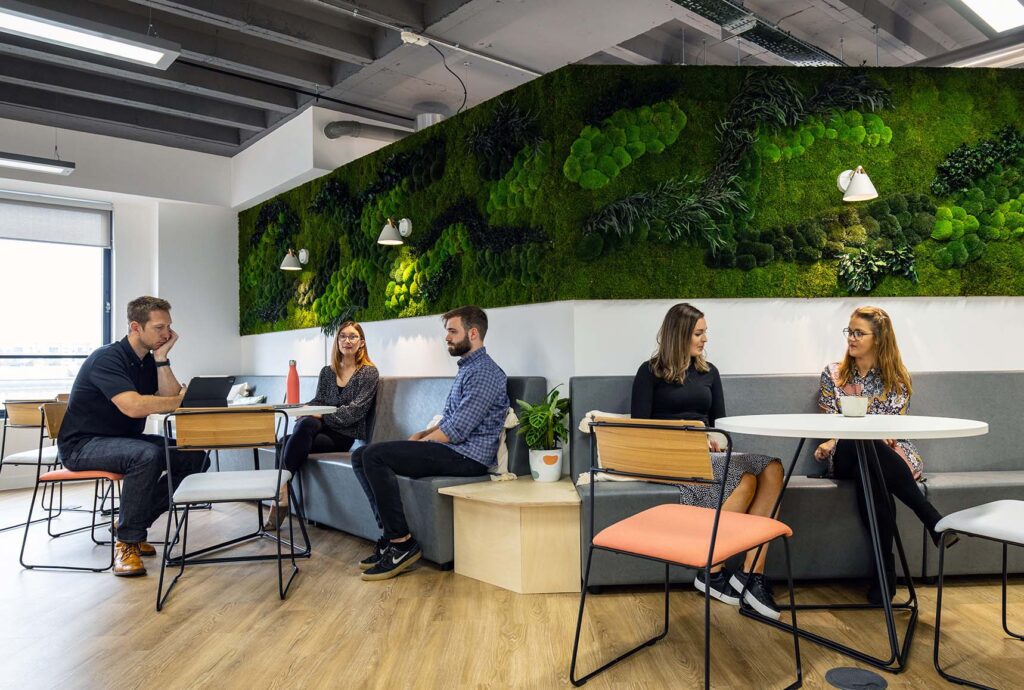
For a practical example of how workplace design can support a health and technology brand, explore our Elvie case study.
Start with strategy, not fit-out
Before you decide on finishes, furniture or a fit-out partner, define what the workplace needs to do.
For scaling health tech businesses, the right office starts with a clear-eyed view of how the business works today and how it needs to grow over the next two to three years. That means understanding your people, your operating model, your sensitive workflows, your team adjacencies and your future headcount before a single design decision is made.
What a strategy-first process actually involves
- Mapping work types (not job titles)
- Identifying “protected activities” (e.g. clinical review, investor comms)
- Adjacency mapping between teams
- Stress-testing against 18–36 month growth scenarios
- Defining non-negotiables (privacy, compliance, acoustic thresholds)
At Interaction, we help ambitious organisations create workplaces that support culture, performance and growth. For health tech companies, that means bridging the gap between innovation and operational confidence, so your office works for your people, your processes and your next stage of scale.
If you’re scaling, hiring, or already seeing strain in your current space, get in touch with us today.
FAQs
What is health tech office design?
Health tech office design refers to the planning and creation of workplaces specifically suited to companies operating at the intersection of technology and healthcare. These businesses have distinct requirements that sit between a standard tech office and a life sciences environment — including the need to support sensitive data workflows, mixed team structures, compliance awareness and rapid growth, while still attracting high-value talent in a competitive market.
How is a health tech office different from a standard tech office?
A standard tech office typically prioritises openness, collaboration and social energy. A health tech office has to do all of that while also supporting controlled work, acoustic privacy, operational discipline and — in some cases — GMP-adjacent or regulated environments. The design brief is more complex, and a generic fit-out is more likely to create friction than to resolve it.
How early should workplace strategy happen in an office project?
Workplace strategy should happen before any design work begins, ideally at the point when the business has identified a need to move, grow or reconfigure its space, but before any floorplates, layouts or finishes have been considered. Getting strategy right first is what prevents costly mistakes later.
How do you design an office that works for both engineers and commercial teams?
Through careful zoning and a clear understanding of how different roles use space. Engineers typically need deep focus, low interruption and stable workstations. Commercial teams need energy, quick access to meeting rooms and space for client activity. These needs aren’t incompatible, but they do require deliberate layout decisions, not a one-size-fits-all open plan.
What does future-proofing an office actually mean?
It means making design and infrastructure decisions today that reduce the cost and disruption of change as the business grows. This includes modular layouts, flexible furniture settings, adaptable meeting room configurations, and a clear view of where pressure on space is likely to build first, typically meeting capacity and acoustic privacy rather than desk count.